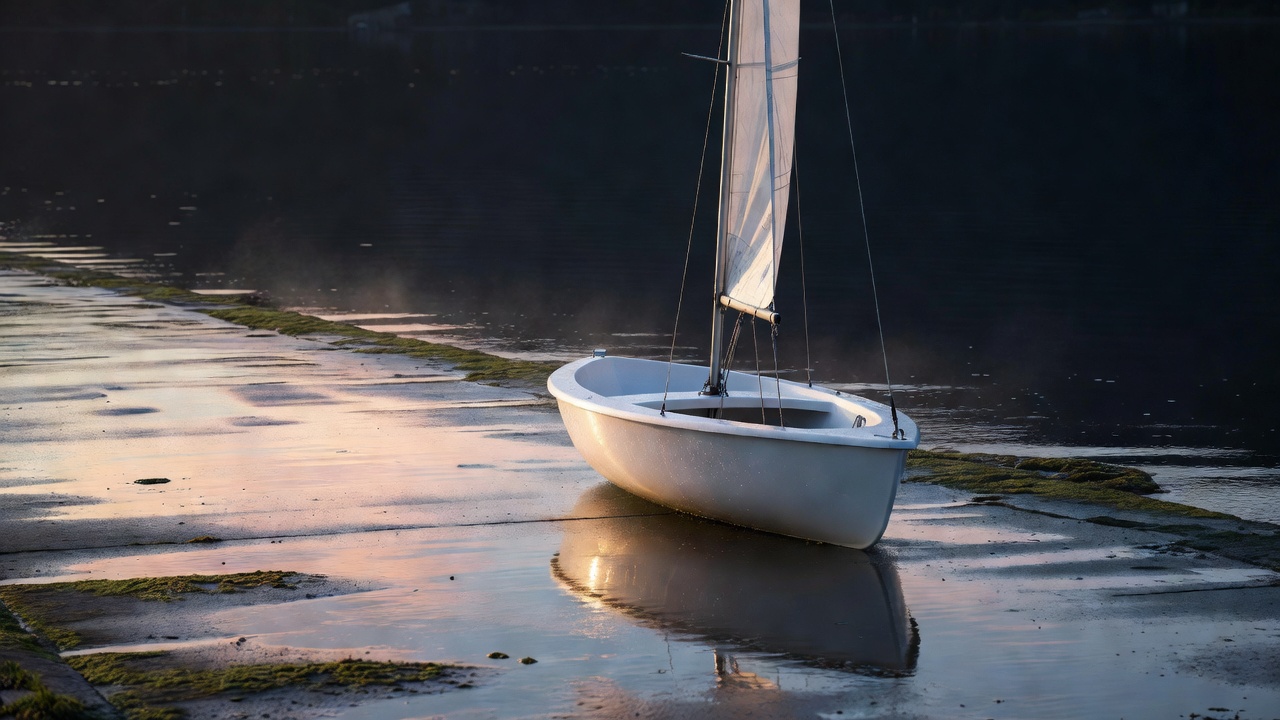
Every winter someone walks into the boat park with a printed list of race results and asks me which dinghy is fastest. Wrong question. The right question is this: can you move it, rig it and right it on your own, on a cold morning, when nobody is watching? If the answer is no, that boat will spend the season under a cover, and you will spend it reading about sailing instead of doing it.
Weight comes first, then stability
A beginner's boat lives a hard life. It is dragged up shingle, launched off a trolley in a crosswind, and capsized far more often than its owner admits. A hull under about 65 kg can be wheeled by one adult and lifted at one end without drama. Above 100 kg you will need a launching trolley, a decent slipway and usually a second pair of hands.
Stability is the other half. A wide, flat hull with a modest sail area forgives clumsy weight shifts. A narrow racing hull rewards precision and punishes hesitation. Both are fine boats. Only one is a good teacher in your first month.
Six classic hulls, logged side by side
These are widely available second-hand in Britain, Europe and North America, which means spare parts, class associations and other owners to ask. Figures are approximate and vary by builder and year.
| Class | Length | Hull weight | Crew | Character | Difficulty |
|---|---|---|---|---|---|
| Optimist | 2.3 m | ~35 kg | 1 child | Designed by Clark Mills in 1947; a stable box built for young sailors. | Easy |
| Topper | 3.4 m | ~43 kg | 1 | Ian Proctor design; tough plastic hull, roof-rack friendly. | Easy |
| Mirror | 3.3 m | ~45 kg | 1–2 | Jack Holt and Barry Bucknell, 1962; wooden kit boat with a red sail. | Easy |
| RS Feva | 3.6 m | ~63 kg | 1–2 | Roomy, modern, with an optional gennaker as skills grow. | Easy–medium |
| ILCA (Laser) | 4.2 m | ~59 kg | 1 | Bruce Kirby's 1970 design; light, lively, tips you in readily. | Medium |
| Wayfarer | 4.8 m | ~170 kg | 2–4 | Ian Proctor, 1957; stable cruising dinghy, needs a trolley. | Easy to sail, hard to move |
Solo, pair, or family
Be honest about who comes with you. If you will usually sail alone, a Topper or similar single-hander is the cheapest way to get time on the tiller. If a friend is learning too, a Mirror or Feva lets you swap helm and crew, which doubles what you both learn. Families who want long, gentle days with a picnic should look at the Wayfarer. It is heavy ashore but reassuringly steady on the water; Frank Dye famously sailed one from Scotland to Iceland in 1963.
Where the boat sleeps
A dinghy kept at a club costs a dinghy park fee but saves you towing, rigging in a car park and arguing with roof bars. A boat kept at home costs nothing to store but adds an hour to every outing. Beginners who keep their boat by the water sail roughly twice as often. That one decision often matters more than the hull itself.
Buying second-hand: what to check
- Soft spots. Press the floor, side decks and transom with your thumb. Flexing or crackling means water in the core.
- Centreboard case and rudder fittings. Look for cracks around the slot and wobble in the pintles.
- Standing rigging. Kinked or rusty shrouds and forestay should be replaced, not admired.
- Sails. Crisp cloth holds shape. Baggy, stretched sails make a boat heel and stall.
- Trolley. Seized wheels on a launching trolley will ruin your first month. Spin them.
Try before you buy
Most clubs run open days in late spring; in the United Kingdom many join the RYA's Push the Boat Out events, and US Sailing lists community sailing centres that offer taster sessions. Hiring for a few hours costs less than a tank of fuel and tells you more than a hundred reviews.
LOG NOTE · INSTRUCTOR
Buy the boat you will actually launch. A slightly dull hull that goes out every Saturday beats a thoroughbred that waits for the perfect day. The perfect day rarely comes.